.png)


Enos Mafokate: The Legend Who Rode Through Apartheid
Updated: Sep 7
THE DEATH this week of Enos Mafokate has robbed South Africa of one of its pioneers and inspirational figures. A black man who took up the equestrian sport during the height of apartheid, Mafokate was one of those who gave the black nation of South Africa hope and confidence that they can be just as good as their white counterparts.
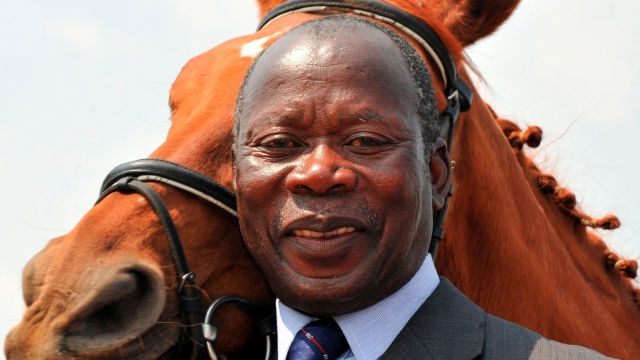
His participation in showjumping events overseas when it was not fashionable for black people to do so set him apart as a pioneer. The man, who died recently at the age of 80, did not stop there but went on to open a show-jumping school in Soweto where he trained many a black children – a legacy that will forever remain.
Though renowned as the father of famous Kwaito artist Arthur Mafokate and his dearly departed younger brother Makhendlas, himself a kwaito singer, Mafokate senior had other children too – some of whom I grew up with in the Limpopo township of Lebowakgomo.
His was a big family and all his children were proud of him, with his youngest daughter Miemie clearly having got daddy’s sporting genes as she is a good runner.
A few years ago, I had the privilege of being at a function at the Birchwood Hotel in Kempton Park when Mafokate received one of the country’s biggest sporting awards – the Andrew Mlangeni Green Jacket. To say the old man was delighted would be putting it mildly. I then met him a few days later at his home in Midrand for an incredibly revealing interview.
I wrote the article from it for the now closed NewFrame. Here it is.
An honour that means more than all the others
FOR A MAN as accomplished as he is, Enos Mafokate’s delight at receiving the Andrew Mlangeni Green Jacket Award resembled that of an upstart winning his first accolade.
This, after all, is a man who has rubbed shoulders with no less a luminary as the Queen of England and has been in the presence of presidents and first wives of many countries too. A man who has the Steve Tshwete Lifetime Achievement Award proudly displayed at his home alongside many other trophies from equestrian events the world over.

But as he walked up to the stage to receive his green jacket from the Minister of Arts, Sports and Culture Nathi Mthethwa the other night, Mafokate was happy personified - his smile bright enough to light up a small village.
The green jacket now over his crisp white shirt and colourful tie while the big cardboard cheque of R20 000 balanced against his knees, Mafokate’s eyes lit up as he took to the microphone. He then raised his hand up and looked to the skies: “Praise be to God” he said, “This is the best honour I could ever get”.
Cue long applause from the audience.
‘Best honour?’ Really?
Well, you see, the fact that the award meant so much for Mafokate is because of its nature. The Andrew Mlangeni Green Jacket Awards are to honour yesteryear’s sports heroes ‘who could not be celebrated because of the restrictive laws of the apartheid regime’.
And boy were those laws restrictive.
'Life was very tough during apartheid'
Despite having endured the ignominy of his family being instructed where to live, a young Mafokate remembers the forced removals that ensured he could never really be certain a place was his home for long.
“In 1958, the GG (the Red Ants of the time) came to our house in Rivonia in January and told us to move out by February or they would be back to break down our house. We had no choice but to move.”
Mafokate also recalled a day when the children of his parents’ employers tried to trick him into electrocution by making him put his wet arm near the switched-on engine of a tractor.
“Once, when I worked on a dairy farm and was delivering milk to the house, I called one of the owner’s daughters by name instead of referring to her as ‘klein missus’. The father did not like that, and he punched me hard on my face. His daughter cried so much that it forced the father to take me to the clinic in Alexandra and I told the nurses no way I am driving back with him. He lied to the nurses that I’d had an accident. But I told them he had punched me and that I didn’t want to drive back with him. They helped me get out of the clinic via the backdoor so I could escape him.”
Those were but some of the hardships the young Mafokate had to endure.
A few days after he had received the Mlangeni award, I met him at his Midrand home – where he was relaxing and playing the role of doting grandfather he so enjoys – for our interview. He told tales of his struggles against apartheid with the same passion he did those of his successes from a pioneering equestrian career that started back in 1962.
Breaking into a white man's sport
Mafokate got into equestrianism after developing a liking for horses while working on farms. He first started as a groom and rode as one against other fellow black stable hands. He proved so good in the sport though that he was soon referred to as a ‘black rider’ and no longer a groom. But that didn’t mean he was treated as an equal by the whites, far from it.
“Hey, I’ve had it rough in my lifetime,” he says “Life was very tough during apartheid and to be a black man in a predominantly white sport was not easy. But let me tell you, it is not as if things changed much after 1994. I’ve had a lot of bad experiences even in recent years.”
I sit up in my chair, my eyes peeled in surprise and my ears now wide open to hear just how a legend of his caliber – he was afforded the honour of being Team SA’s ambassador when we went back to the Olympics at Barcelona 92 for Pete’s sakes – could have had it bad post-apartheid.
Mafokate then shares tales of the bad treatments he has endured from some racist whites who just could not seem to accept that a black man could be participating in a sport they clearly see as their preserve.
Racism did not end in 1994
“In 2000 I went to an event in Thabazimbi and when I arrived at the gate, there were three Afrikaners who wanted me to pay to get in. But I told them I had already registered as a participant. They asked me whose car it was that I was driving. ‘Waar’s die baas? (where’s the boss)” they asked me. I told them it was my car and that ‘ek is die baas’ (I am the boss). They got angry with me and told me to park on the side of the road while they were letting other white people through. They were saying I should show them the receipt as proof that I bought the horse. Peter, the organiser of the event came through and asked why my horse box and car were on the side of the road and suddenly they allowed me to go through. As I walked away, I cheekily said to them ‘fuck you. I have thousands of horses and about 400 people working for me.’ They were seething, but I didn’t care.”
Good for you Oom Enos!
It was not long though before he got yet another experience and reminder that a significant part of South Africa remained racist.
“There was a competition in Ellisras in 2001 and I took a few of my kids (Mafokate has an Equestrian school at the Elkah Stadium in Rockville, Soweto which he opened in 1997) there. We competed and did very well because we won 11 of the 12 classes we participated in. After the events when we were at the food stalls there were some white boys drinking at the bar. I wanted to buy the kids drinks and these boys said to me ‘even if you can ride a horse, you are still a kaffir’. I could have told them where to get off, but I was careful not to expose the young children to what could have turned out into an ugly altercation, so I decided to leave that place.”
Mafokate stormed off and the organisers didn’t take kindly to this and invited him to another event in 2004 during which ‘they treated me like I was Mandela’.
From South Africa to the world stage
He has experienced such VIP treatment only outside the country though, Mafokate having become so good in show-jumping that he was invited to the United Kingdom for the first time in 1980 after being spotted here at home by David Broome.
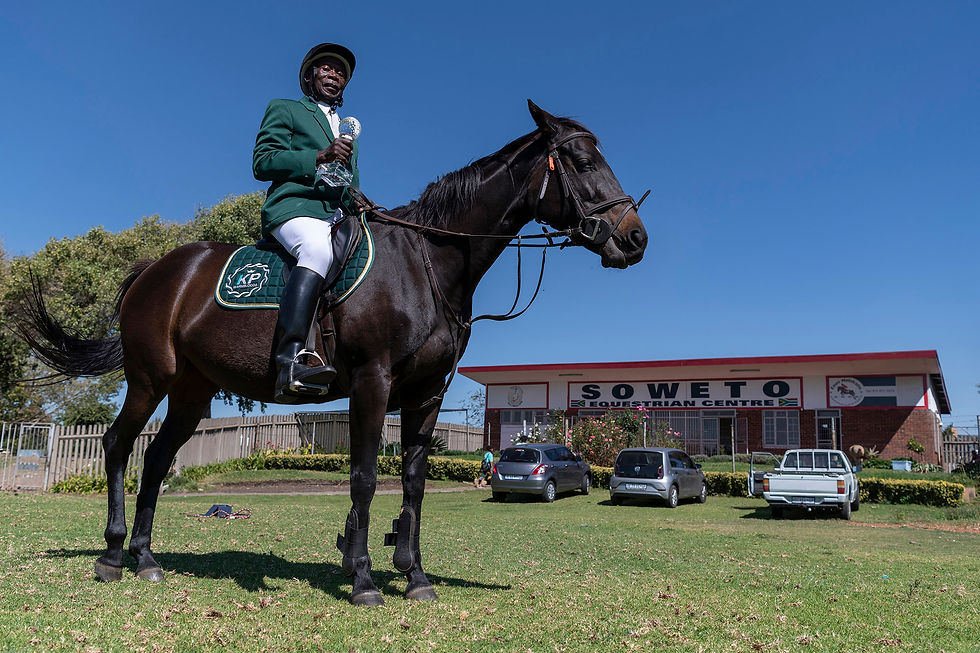
“I’d won the blacks only championships in Cape Town from 1977 to 1979 and was also the first black man to participate at the Royal Agriculture Show in Pietermaritzburg in 1978 after PW Botha (then Republic president) instructed them to grant me a temporary license.”
For the UK event, Mafokate’s application to compete was initially declined because of apartheid. But his employer Anneli Wucherpfennig asked her aunt Queen Elizabeth to help and only at the instruction of Her Majesty did they allow him to compete.
He lightens up at the memory of that trip: “I was the first black person to perform at the Royal Horse Show at Wembley in London. But before the performance in London, we went to Wales where I won in one class and finished second in the championship. I remember that when we arrived early on, the entire street leading up to the venue was filled with people. They all wanted to see this black man who could ride horses. It was something unheard of. It was a great feeling. I did my part to show that black South Africans were capable even though the apartheid government was trying to reduce us to nothing.”
Such was his showing then that he went on to compete in the UK for the next three years and “in 1984 I won the Midlands Championship in England in front of a crowd of 65 000 people. It is my biggest win in equestrian”.
When winning was never enough
Mafokate’s pioneering ways did not, however, make him immune to apartheid in his country of birth.
With apartheid at its height in the eighties, Mafokate remembers how white judges would deny him victory via ridiculous reasons.
“At one event, a judge said I didn’t win because my horse was old. But we discovered that mine was younger than the one that had won. But when asked by others the same judge said I was not sitting properly on the horse, that is why I did not win. It was crazy. They couldn’t let me win the overall King George prize just because I was black.”
Guarding a horse against apartheid
Not as crazy as the time when he had to get his son Arthur Mafokate – the Kwaito superstar – to sleep with his horse back in 1986.
“I was competing in Lebowakgomo, Limpopo and the whites were clearly not pleased with my presence and they made it clear. Firstly, they told me I could not park where I had parked – near all the other competitors and I had to move my car. They were so against me that I just didn’t trust them. So, I got my son Arthur to guard my horse through the night because I couldn’t trust those white guys not to poison my horse.”
At another event that he won, Mafokate remembers a young white boy coming over to him after the event.
“I really thought he was coming to congratulate me, but he asked me where I’d got the red jacket I was wearing. I said to him, ‘I stole it’ and he cried and went back to his father who was very furious with me for making his son cry. I just laughed them off.”
As the first black member of the Transvaal Riders Association, he remembers winning over a white lady in 1977 in Klerksdorp.
“She was watching me doing my final ride and when she became aware that I was going to beat her, she went to her car and stormed off – creating a lot of dust as she did. She didn’t even stay on for the prize-giving and sent her groom to get her prize for her.”
Tough as he had got it, Mafokate could not be dissuaded from his favourite sport and he went on to become a legend of the sport, his joining the S.P.C.A (Society for the Prevention of Cruelty against Animals) in Soweto helped see the locals treat animals – particularly horses with better care.
A legacy that reaches beyond the saddle
Over the years, he has helped get a lot of youngsters – no less than three of whom are his direct grandchildren - into show-jumping through the Enos Mafokate Soweto Equestrian Centre.
“I took my kids to the 2010 World Equestrian Games in America and they really did well there.”
That he was among the recipients of the Andrew Mlangeni Green Jackets Awards the other night was no fluke, although he found it to be a pleasant surprise.
“This award really means a lot to me because of what I’ve gone through. I helped Tony Lewis and Anneli to become Springboks in the 80s. But when I asked that I be given the colours too they refused because I was black. So, for me to get this Andrew Mlangeni "it is the biggest honour".

Mafokate recalls that he had initially thought the Mlangeni Awards were reserved for others.
“In 2018, I was at the awards and when I saw the jackets, I thought the awards were for golfers (the awards emblem has two golf clubs and a ball) but I was surprised when I saw the names of Makhaya Ntini and Teenage Dladla among those who were honoured before. Only then did I realise what these Andrew Mlangeni Awards are really about. And to now also be honoured this way, man it means everything for me. It is the biggest honour.”

Comments